
TGA 4-MBC Consultation 2026: Why Only Option 3 Protects Australians

By an Australian Sunscreen Council Contributor
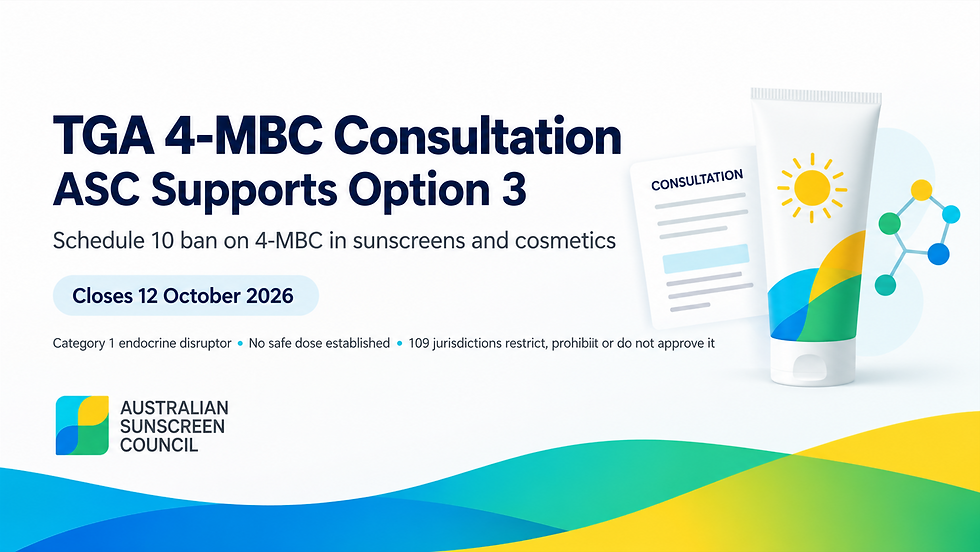
The TGA is consulting on how to regulate 4-MBC (4-methylbenzylidene camphor), a chemical UV filter used in Australian sunscreens, and public submissions close on 12 October 2026 [1]. The Australian Sunscreen Council supports Option 3: a Schedule 10 ban on 4-MBC in therapeutic goods and cosmetic products. This article sets out why. Almost all of the evidence comes from the TGA's own documents. Numbers in square brackets refer to the sources listed at the end.
What the TGA is proposing on 4-MBC
4-MBC is currently permitted in Australian sunscreens at up to 4%. As of 25 August 2026, 107 medicines on the Australian Register of Therapeutic Goods contain it [1]. The TGA's scheduling committees will meet in November 2026 to consider three options [1]:
Option 1: a Schedule 5 "CAUTION" entry, with products containing 0.39% or less exempt.
Option 2: a Schedule 5 entry with exemptions of up to 3.8% in adult face-and-hands sunscreens and 3.3% in cosmetics.
Option 3: a Schedule 10 entry, prohibiting 4-MBC in therapeutic goods and cosmetics.
Options 1 and 2 are the Delegate's proposals. Option 3 came from two applicants who asked for a full ban [1].
4-MBC at a glance: what the record shows
It is a Category 1 endocrine disruptor, the highest tier; the lower tiers are "suspected" and "indicated". A UN Environment report lists it among just 45 chemicals, out of more than 1,000 flagged worldwide, identified as endocrine disruptors after thorough scientific assessment [2].
It interferes with the thyroid. In animal studies it caused thyroid overgrowth and enlargement, including in offspring exposed before birth [3, 4].
It acts like oestrogen. It increases uterine weight in young animals and makes human breast cancer cells multiply in the laboratory [4, 5].
It disrupts development. In animal studies, exposure in the womb delayed puberty and reduced prostate weight in males, altered sexual behaviour in females, and changed hormone-receptor gene expression in the developing brain [4].
It gets into people. It has been measured in human blood, urine, breast milk and breast tissue [4, 6, 7, 8].
There is no cancer study for it on the regulatory record, and its genotoxicity has never been resolved [4, 5, 9].
It is very toxic to aquatic life, with long-lasting effects [1].
It is prohibited, restricted or not approved in 109 jurisdictions, including the EU, the UK, China, the United States and Japan [10].
No regulator anywhere has found a safe level of use, including the TGA [5, 9, 11].
The TGA's own words: "a safe dose... cannot be established"
In January 2026 the TGA refused an application to remove 4-MBC from the list of ingredients permitted in listed medicines. You can read our coverage of the original removal application. But in the same Notice of Decision, the TGA's delegate wrote [11]:
"I concur with the evaluator that a MoS of 4-MBC cannot be reached, and consequently, a safe dose of the ingredient cannot be established."
And:
"Although a SED has been established at 1.4 mg/kg bw/day, a systemic NOAEL could not be determined. As a result a MoS cannot be arrived and a safe dose of 4-MBC cannot be reached."
The same notice listed the benefits of removing 4-MBC, again in the TGA's own words. Removal would "reduce exposure of Australian public to potential endocrine modulating activity of 4-MBC" and "mitigate the risk of exposing Australian public to an unknown genotoxic potential of 4-MBC" [11]. The TGA identified the risk and the benefit of acting, and chose to keep the risk.
Eight months later, the consultation proposes exact thresholds of 0.39%, 0.95%, 3.3% and 3.8%. Each is described as "low-risk", and none is described as safe [1]. The consultation notice gives no no-effect dose or safety margin for any of them.
Twenty-five years of warnings
Documents released under Freedom of Information show a regulator that was warned repeatedly and chose to wait each time.
2001. A TGA safety alert recorded that the Danish EPA "indicated that suntan lotions containing 4-MBC should not be used on children under 12 years of age." The TGA concluded no action was needed [12].
2005. A TGA internal file note recorded "hypertrophy and hyperplasia of thyroid epithelium" in rats. It noted that "no data were available on the long term consequences of prolonged thyroid stimulation" and that "a no-effect level cannot be determined." Its recommendation: "there is no cause for urgent action and hence it is recommended that we wait for the outcome of the SCCP's evaluation" [3]. Europe finished that evaluation and banned 4-MBC. Australia is still waiting.
2012. Denmark's Centre on Endocrine Disrupters classified 4-MBC as a Category 1 endocrine disruptor [2, 13].
2022. A TGA internal briefing recorded that 4-MBC at 4% "does not appear to be safe due to endocrine disrupting potential", and that 206 listed sunscreens contained it [14].
2024. TGA staff asked internally: "could we also prioritise the safety review of 4-MBC" [14].
2025. The TGA's own safety evaluation recorded "strong evidence of endocrine activity modulation" of the thyroid and "strong evidence for estrogenic effect". It recorded that exposure in the womb "delayed puberty onset in male rats" and caused thyroid weight increases in offspring "even at 7 mg/kg bw/day". It also found that "the safety risks for the use of 4-MBC over long periods of time cannot be determined", and that the lack of cancer data "cannot be justified" [4].
A Category 1 endocrine disruptor: one of 45 chemicals out of more than 1,000
In July 2017 UN Environment published Overview Report I: Worldwide initiatives to identify endocrine disrupting chemicals (EDCs) and potential EDCs [2]. The report surveyed 28 initiatives worldwide, which between them had flagged more than 1,000 chemicals. It then kept only those that had passed "at least one thorough scientific assessment using the WHO/IPCS definitions." Just 45 chemicals or groups of chemicals made that list. 4-MBC is one of them.
4-MBC carries two Category 1 ratings in the report [2]:
Denmark: Category 1, "endocrine disruptor" [13]. This is the top tier, above "suspected" and "indicated". It requires "adverse in vivo effects where an ED mode of action is highly plausible". In other words, harm has been observed in living animals and is clearly linked to a hormonal mechanism.
The European Commission's Priority List: Category 1, meaning "at least one study showing evidence of ED in an intact organism."
The report uses the WHO definition of an endocrine disruptor, a substance that "causes adverse health effects in an intact organism, or its progeny" [2]. The words "or its progeny" matter. The TGA's own evaluation records exactly that kind of harm in offspring exposed before birth [4].
Category 1 measures how strong the evidence is, not how potent the chemical is. On the strength of that evidence, 4-MBC sits in the same tier as certain phthalates, the antibacterial triclosan, and pentachlorophenol, a pesticide listed for global elimination under the Stockholm Convention [2, 15].
Australia was in the room when this information was asked for. At the International Conference on Chemicals Management in Nairobi in 2012, Australia was one of the governments represented when the Conference declared endocrine disruptors a global policy issue [16]. The Conference called for information to support "reductions in exposures to or the effects of endocrine-disrupting chemicals, in particular among vulnerable populations" [16]. The UN report was that information, and it named 4-MBC [2]. Fourteen years later, Australian families are still putting it on their skin every day.
Every regulator that has looked has reached the same conclusion
The EU Scientific Committee on Consumer Safety (2022) found "sufficient evidence that 4-MBC may act as an endocrine disruptor." It went further: "Even if the genotoxic potential was excluded... the use of 4-MBC at the maximum concentration of 4%... would not be safe" [5].
The UK's Scientific Advisory Group on Chemical Safety (2025) concluded that 4-MBC "should be regarded as a reproductive and developmental toxicant" and meets the WHO definition of an endocrine disruptor. Its members "were not able to derive a safe level" [9].
The European Chemicals Agency unanimously listed 4-MBC as a Substance of Very High Concern, citing "scientific evidence of probable serious effects to human health" [5, 17].
The calculation fails even on the most generous numbers on record. Take the European committee's no-effect dose (25 mg/kg bw/day) [5], its lowered safety threshold (a margin of 25 instead of the usual 100) [11] and the TGA's own exposure estimate (1.4 mg/kg bw/day) [4]. The margin of safety for 4% 4-MBC comes out at about 18. That fails the European committee's own lowered bar, and it is less than a fifth of the conventional 100.
Europe banned 4-MBC from sale on 1 May 2026 [18]. The UK ends all sales in January 2027 [1], China bans it from January 2027 [19], and the US has never approved it [20]. Of the major regulators, only Canada and Australia still allow it [1].
Why Options 1 and 2 fall short
4-MBC fails the TGA's own test for Schedule 5. Under the national Scheduling Policy Framework, a Schedule 5 substance must have "a low health hazard" and "no other significant toxicity (e.g. respiratory sensitisation, mutagenicity, carcinogenicity, reproductive toxicity etc)" [21]. 4-MBC is a Category 1 endocrine disruptor that the UK regards as a reproductive and developmental toxicant [2, 9]. Its genotoxicity has not been ruled out, and it has no cancer data [4, 5]. It does not fit Schedule 5 at any concentration.
It meets the test for Schedule 10. Schedule 10 covers substances posing "such a high public health risk, including potential risk," that access should generally be prohibited, where the risk "substantially outweighs the benefit" [21]. The framework does not demand proof of harm in humans; potential risk is enough. And the benefit on the other side of the scale is not the benefit of sunscreen. It is the benefit of this one filter, and that is close to nil.
A caution label cannot fix a hormone problem. Today the only required warnings on 4-MBC sunscreens are "Avoid prolonged exposure in the sun" and "Wear protective clothing" [1]. Pregnant women get no warning of any kind about endocrine effects, and a Schedule 5 "CAUTION" label would not change that.
Option 2 is barely a change. It allows 3.8% in daily-use adult face sunscreens, against today's 4%, and 3.3% in face creams, foundations and lip balms [1]. Those cosmetic products don't even offer the skin-cancer benefit the TGA relied on to keep 4-MBC [11].
The TGA's reasons for waiting no longer apply
"Removal would disrupt supply." In January the TGA worried that products would need to be pulled "immediately". It named scheduling as the better route because it allows an orderly transition [11]. This consultation is that route. And the Delegate's own options already force reformulation. A Schedule 5 substance "cannot be used in Listed medicines", and Option 2 gives no exemption at all to whole-body sunscreens [1]. Reformulation is coming under every option; only Option 3 finishes the job.
"4-MBC helps prevent skin cancer." Sunscreen helps prevent skin cancer, and 4-MBC is not needed for sunscreen to work. 88% of listed sunscreens in Australia already do without it, and more than 20 alternative UV filters are approved [1].
"Harm hasn't been proven in humans." No one will ever be allowed to run that trial. Under the Therapeutic Goods Act the burden is on proving an ingredient safe, not on the public proving it harmful. The industry has had twenty years to supply the data:
The key rat studies were conducted before 1985 [3].
The EU received a spreadsheet instead of full study reports [5].
When the UK asked industry for data, "no additional data were received" [9].
The 3-BC and oxybenzone double standard
4-MBC's closest chemical relative, 3-benzylidene camphor (3-BC), differs by a single methyl group and carries the same Category 1 ratings [2]. The EU banned 3-BC in 2015 [22]. Australia has never approved it as an active ingredient in therapeutic sunscreens [23]. Its methylated twin is allowed at 4%.
In the same UN report, oxybenzone is rated only Category 2a, "suspected" [2], yet the TGA proposed restricting oxybenzone under Schedule 5 in 2025 [24]. 4-MBC is rated a full tier higher and has no safe dose [2, 11]. It cannot logically get the same treatment as a "suspected" disruptor, let alone exemptions up to 3.8%.
Make your own submission before 12 October 2026
The TGA wants to hear from the public, and every submission is considered by the joint scheduling committees. If you believe 4-MBC has no place in Australian sunscreens, you can say so.
Closes: close of business, 12 October 2026.
How: open the consultation page and click "Submit your response here".
Privacy: submissions are published on the TGA website unless marked confidential. For individuals, all personal details other than your name are removed before publication, and you can ask not to be identified.
Points you may wish to make, in your own words:
You support Option 3, a Schedule 10 ban on 4-MBC in therapeutic goods and cosmetics.
The TGA itself has found that "a safe dose of the ingredient cannot be established."
4-MBC is a Category 1 endocrine disruptor that is banned or not approved in 109 jurisdictions.
A caution label cannot protect children or pregnant women from a hormone-disrupting chemical.
88% of Australian sunscreens already do without it, so it isn't needed.
A few sentences in your own words carry weight. Your submission doesn't need to be long.
Frequently asked questions
Is 4-MBC banned in Australia?
No. It is currently permitted in sunscreens at up to 4%. The TGA is now consulting on whether to restrict it (Options 1 and 2) or ban it (Option 3).
Should I stop using sunscreen?
No. Sunscreen remains one of the most important tools for preventing skin cancer, alongside shade, clothing, hats and sunglasses. If you want to avoid 4-MBC, check the active ingredients on the label for "4-methylbenzylidene camphor" or "enzacamene", and choose one of the many sunscreens that don't contain it, including mineral (zinc oxide) sunscreens.
What does "Category 1 endocrine disruptor" mean?
Under Denmark's criteria, it is the highest of three tiers. It means harm has been observed in living animals and is clearly linked to a hormone-disrupting mechanism, rather than being merely "suspected" or "indicated".
Who can make a submission?
Anyone. You don't need to be a scientist or represent an organisation.
Sources
TGA, Consultation: Proposed amendments to the Poisons Standard in relation to 4-methylbenzylidene camphor (4-MBC), Joint ACMS-ACCS #45, November 2026, 11 September 2026. Consultation page
UN Environment (prepared by the International Panel on Chemical Pollution), Overview Report I: Worldwide initiatives to identify endocrine disrupting chemicals (EDCs) and potential EDCs, July 2017, section 4 and Table 6.
TGA, File Note: 4-Methylbenzylidene camphor, 11 November 2005. Released under FOI 25-0009 (Document 11) and FOI 26-2630 (Doc 04).
TGA Complementary Medicines Evaluation Section, Safety Evaluation: 4-methylbenzylidene camphor (D25-3595798). Released under FOI 26-2630 (Doc 08), August 2026.
European Commission, Scientific Committee on Consumer Safety, Final Opinion on 4-Methylbenzylidene camphor (4-MBC), SCCS/1640/21, 2022.
Murawski A. et al. (2021). Metabolites of 4-MBC, BHT and TOTM in urine of children and adolescents in Germany (GerES V). Environmental Research 192:110345. doi:10.1016/j.envres.2020.110345
Schlumpf M. et al. (2008). Endocrine active UV filters: developmental toxicity and exposure through breast milk. Chimia 62:345–351.
Barr L., Alamer M. and Darbre P.D. (2018). Measurement of concentrations of four chemical UV filters in human breast tissue at serial locations across the breast. Journal of Applied Toxicology.
UK Office for Product Safety and Standards, Scientific Advisory Group on Chemical Safety, Opinion 18: 4-Methylbenzylidene Camphor as a UV Filter in Cosmetic Products, 2025.
Australian Sunscreen Council, 109 Jurisdictions Prohibit 4-MBC Sunscreen Filter (TGA Lags Behind), 27 May 2026. The jurisdiction-by-jurisdiction source register.
TGA, Notice of Decision to Refuse to make a Recommendation to vary the Section 26BB Determination (4-methylbenzylidene camphor), IN-2025-AP-000920, 16 January 2026.
TGA, Safety alert: Sunscreens: potential oestrogenicity of sunscreens, 2001.
Hass U. et al., Evaluation of 22 SIN List 2.0 substances according to the Danish proposal on criteria for endocrine disrupters, Danish Centre on Endocrine Disrupters for the Danish EPA, 2012.
TGA internal briefing (May 2022) and internal correspondence (August 2024). Released under FOI 25-0010.
Stockholm Convention on Persistent Organic Pollutants, Annex A: pentachlorophenol and its salts and esters, listed 2015.
International Conference on Chemicals Management, third session (Nairobi, 17–21 September 2012), Report, SAICM/ICCM.3/24, attendance (para. 22) and resolution III/2 F on endocrine-disrupting chemicals.
European Chemicals Agency, Candidate List of substances of very high concern: 3-(4-methylbenzylidene)camphor, endocrine-disrupting properties (Article 57(f)), added 17 January 2022.
Commission Regulation (EU) 2024/996, moving 4-MBC to Annex II (prohibited substances).
National Medical Products Administration (China), Announcement No. 6 of 2026, 12 January 2026.
US FDA, proposed order on the regulatory status of enzacamene (4-MBC) in over-the-counter sunscreens, 25 February 2015.
Australian Health Ministers' Advisory Council, Scheduling Policy Framework for Medicines and Chemicals, factors for Schedules 5 and 10, updated 18 January 2018.
Commission Regulation (EU) 2015/1298, prohibiting 3-benzylidene camphor in cosmetic products.
NICNAS, 3-Benzylidene camphor: Human health tier II assessment, 29 June 2020.
TGA, Pre-meeting public notice: Proposed amendments to the Poisons Standard (homosalate, oxybenzone, benzophenone), Joint ACMS-ACCS meeting, September 2025. Published 8 July 2025.
About the Australian Sunscreen Council
The Australian Sunscreen Council is Australia’s peak industry body for sunscreen safety and a registered charity ABN 64 692 134 982. The Council works with scientists, medical professionals, industry experts and policymakers to promote evidence-based sunscreen safety, UV protection education and stronger public-health standards.
For more information, to join the Council, or to support our work on regulatory reform, visit the official Australian Sunscreen Council website australiansunscreencouncil.org.

Australian Sunscreen Council Editorial Team
The Council is supported by an Expert Group and may draw on advice from one or more members depending on the subject matter of a particular article, submission or publication. Members listed by the Council include:
Dr Craig Downs, Executive Director, Haereticus Environmental Laboratory
Dr Russell Hills, cosmetic and laser dermatologist and Mohs specialist
Dr Denis Dudley, obstetrician-gynaecologist and endocrinologist
Dr Abhinandan “Rocky” Chowdhury, toxicologist
Dr Leslie Laquieze, sunscreen testing and photoprotection
Mgr. Mehrdad Mirzaei, pharmacist and photoprotection researcher
Joseph DiNardo, cosmetic toxicologist
Dr Alan Jones, skin cancer physician
Camila Biato Stopa, MSc, cosmetic scientist and pharmacist


